

Acoustic analysis of mixing and mastering studios
What problem are we solving?
Even the best monitors do not sound accurate in an untreated room. Standing waves (modes), early reflections and left–right asymmetry “fool” your hearing – the mix sounds good in the studio and bad everywhere else.
By measuring, we find which frequencies and which reflections are the problem, and whether they can be solved with panels, by moving the monitors – or are a limitation of the room itself.

Standards and status of the measurement
We assess the room against the recommendations for control rooms and critical listening rooms: EBU Tech 3276 “Listening Conditions for the Assessment of Mono & Stereo Sound” and ITU-R BS.1116. They set requirements for the reverberation time according to the room volume, for early reflections and for background noise.
The measurement is an engineering assessment and is not accredited.
Equipment: What do we use to measure?
To achieve linear and repeatable results, we use a proven measurement chain:
- iSemcon EMX-7150: Reference measurement microphone with an extremely flat frequency response, designed for precise acoustic analysis.
- REW (Room EQ Wizard): Specialized software for acoustic measurements, recognized as a standard in industrial and professional practice.
- Behringer Audio Interface: External sound card for clean signal transmission without coloration.
- Monitor columns: The preferred option is to perform the measurement with your own columns, to analyze the real combination between equipment and premises. For studios in the initial stage of construction, we can provide our sources for an initial test.
Practical use
This service is indispensable for:
- Professional studios: To achieve "translatability" of mixes (the sound should sound equally good on all systems).
- Home studios: Maximum improvement of acoustics in small or asymmetrical rooms.
- Podcast and sound recording studios: Reverb and voice clarity control.
- Investment solutions: Before purchasing expensive monitors, assess whether the room can "accommodate" them.
Process and Analysis: What Does the Client Get?
The measurement includes a complete diagnosis of the studio's "acoustic footprint". The client receives a report with the following parameters:
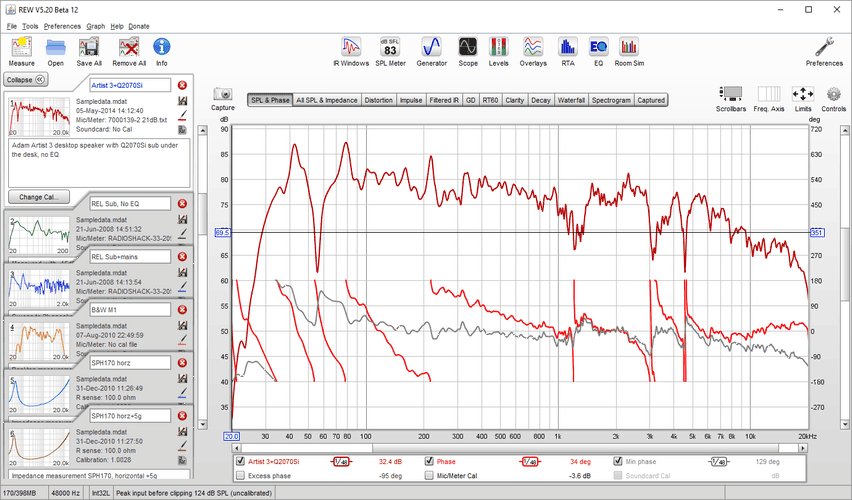
- Modal analysis (Standing Waves): Localizing standing waves in the low-frequency spectrum that cause "buzz" or lack of bass.
- Frequency Response (FR): A graph showing the linearity of the sound at the listening point.
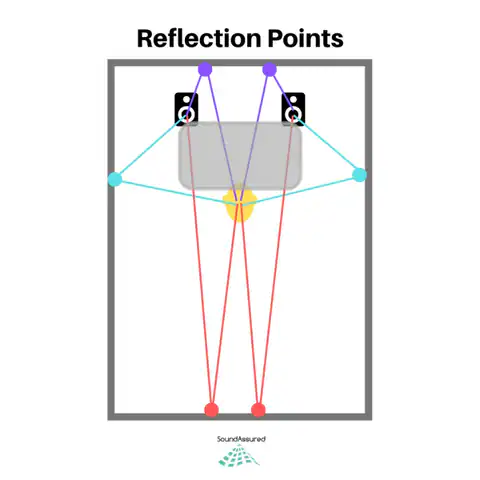
- Reflection analysis (ETC): Identifying early reflections that blur the stereo picture.
- Impulse characteristic (IR): Assessment of the time characteristics of the room.
- Sweet Spot Optimization: Consultation on the best placement of the workplace and monitors.
Note: Acoustic Force does not perform software or hardware tuning (DSP/EQ) of the customer's equipment. We provide physical optimization solutions of the room (bass traps, diffusers, absorbers) that solve the problems at their root.
Example: Urban House Studio, Sofia (2026)
We measured both control rooms of the studio – with their own monitors (ADAM A77X and Genelec 1032B), at the listening position.
Control room 1 (trapezoidal, about 50 m³). Mid and high frequencies are well controlled – EDT and T20 about 0.15–0.20 s above 200 Hz. After measuring the distances, we centred the monitors and the screens: the left–right difference in early reflections dropped from 3–5 dB to below 2 dB. Below 100 Hz, standing waves remained at about 50 and 65–70 Hz (+7–8 dB, decay over 1.3 s). They would need absorbers more than 1 m deep, so we honestly described them as a limitation of the room.
Control room 2 (LEDE, monitors flush-mounted in the wall). Good time symmetry between the channels – below 2 dB. We found a dip at about 112–135 Hz (18–20 dB) caused by the construction, and a difference of up to 9 dB between the channels above 400 Hz due to the windows on one side. We recommended setting the monitor filters for flush mounting (Bass Roll-off) and curtains or panels in front of the windows.
Frequently Asked Questions
Why is it better to measure with my columns?
The interaction between specific speakers and the room is unique. Measuring with your equipment gives the most accurate idea of how you hear music in your daily work.
Can you tell me exactly where to place the panels after measuring?
Yes, the main goal of the analysis is to provide specific solutions – where the weak spots are and what acoustic elements (and where) should be placed for the best effect.
How long does the session take?
A standard measurement with subsequent analysis takes between 2 and 4 hours on site.



"*" indicates required fields