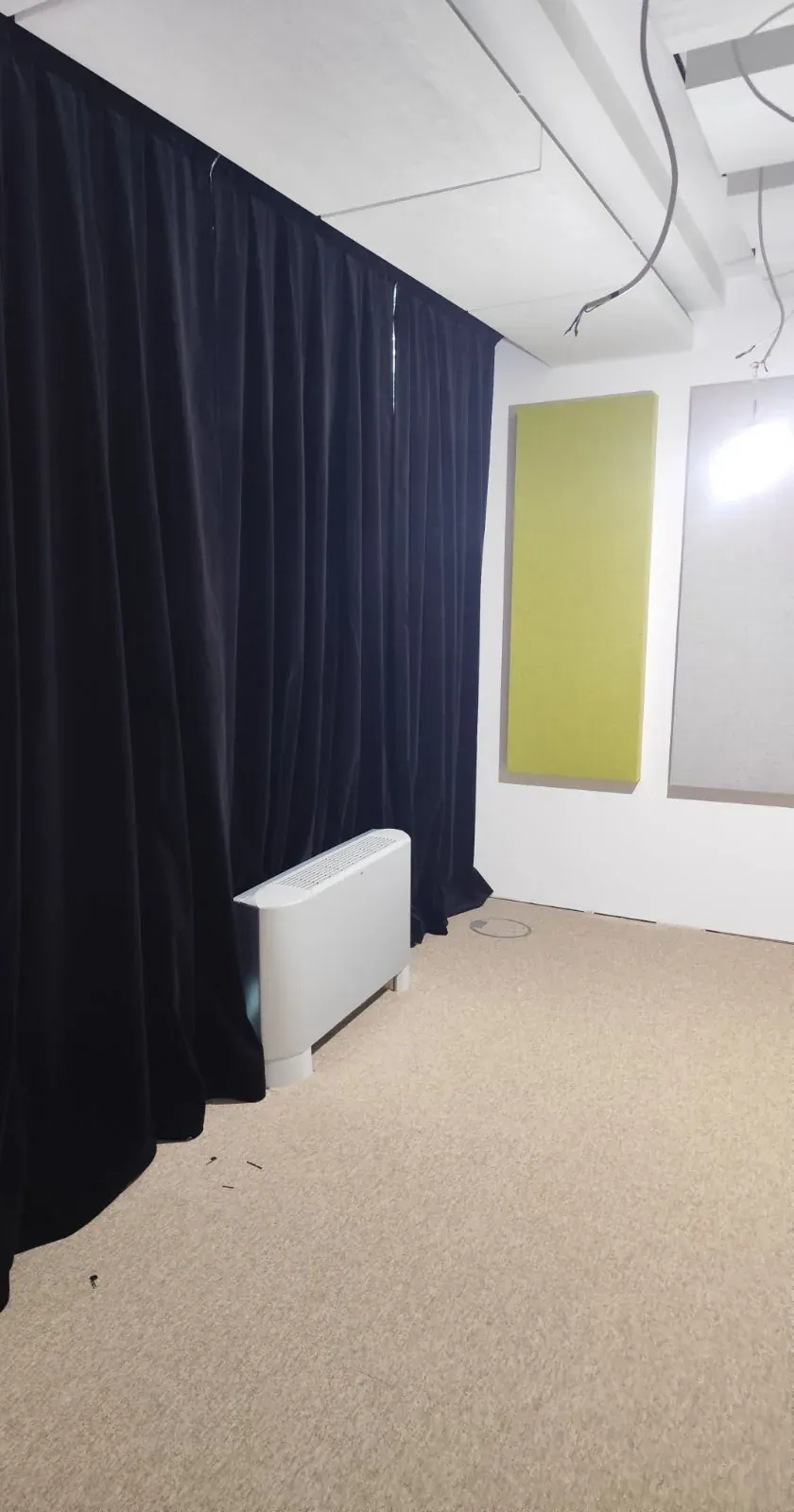
Acoustic and Soundproofing Curtains
A heavy acoustic curtain absorbs sound in the room and reduces echo. It divides a large space into zones without a wall, and when needed it becomes one space again. It suits event and training rooms, stages, gyms and meeting rooms.
What curtains do not do
A curtain is not a wall. Between two rooms it adds a few decibels of sound insulation. In our project for ATENDIA we measured a difference of 4.5 dB between the two rooms – with pink noise, with and without the curtains. The difference is clearly audible, but it is not “twice as quiet” – that takes about 10 dB.
The heavier the fabric and the more layers, the better the curtain insulates. Gaps at the top, sides and bottom, however, greatly reduce the effect, so the curtain reaches the ceiling and the floor. When more sound insulation is needed, the solution is a barrier – a wall or a movable wall with a higher rating.
Execution
- we sew the curtain to size – single, double or multi-layer;
- we choose a track rated for the curtain’s weight, with bent corners where needed;
- the curtain reaches the ceiling and the floor, so there are no gaps;
- the Kleber and Davout fabrics are flame-retardant, reaction-to-fire class M1 (French classification).
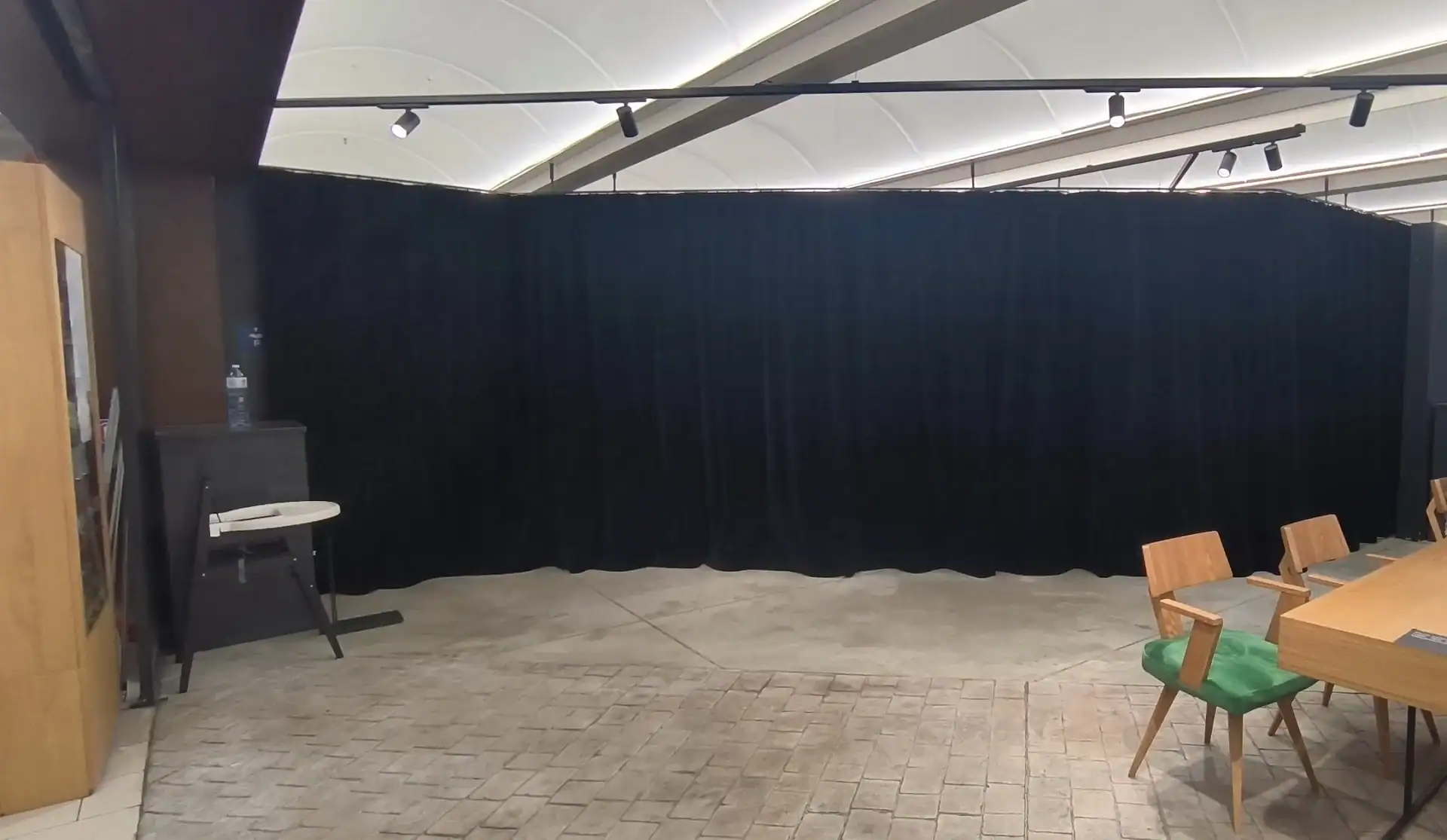
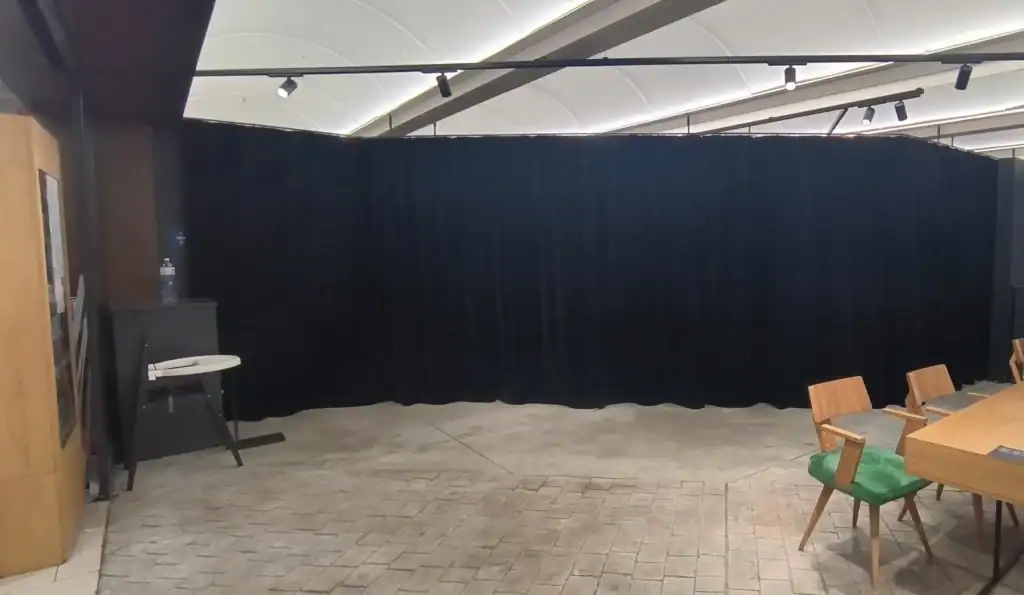
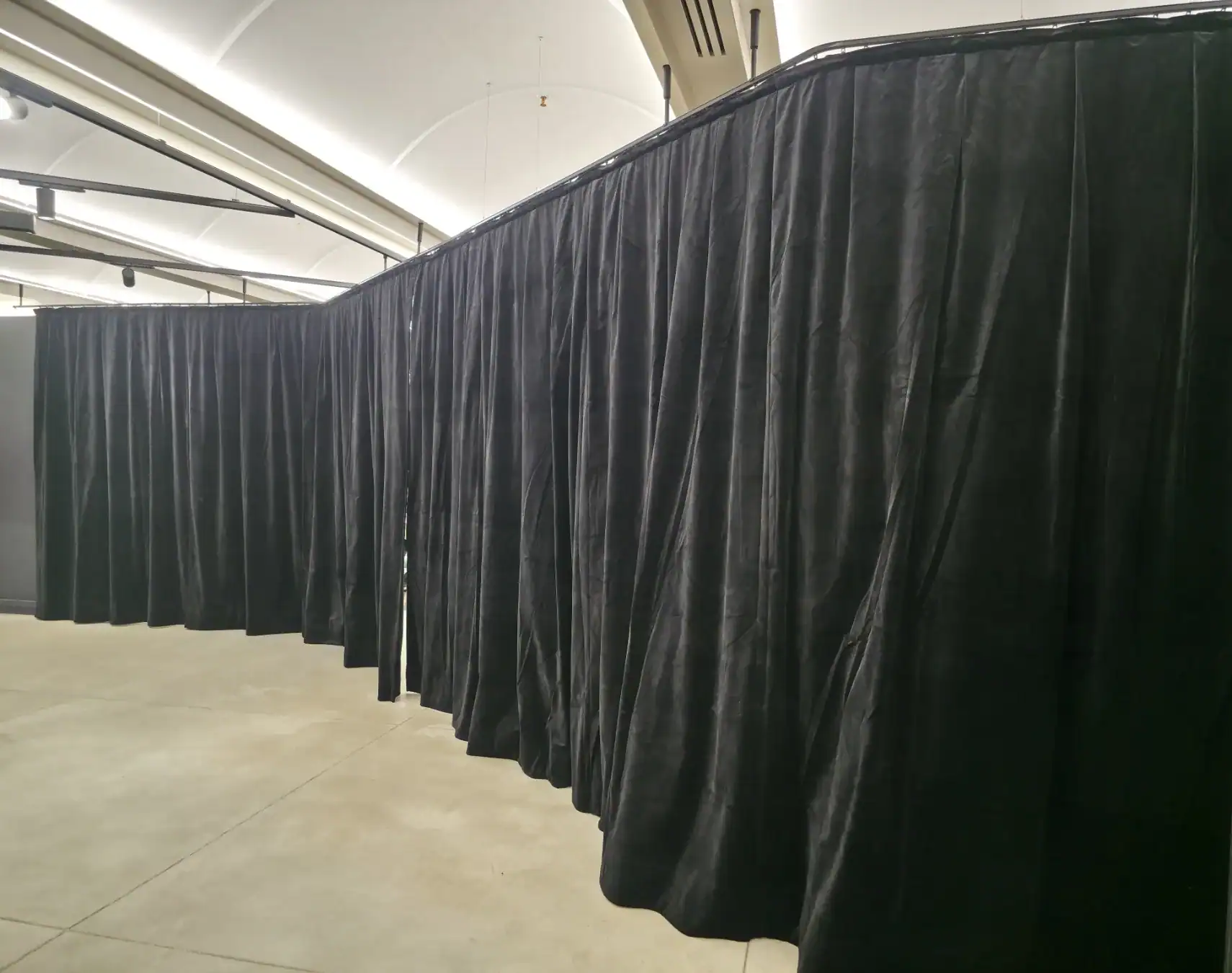
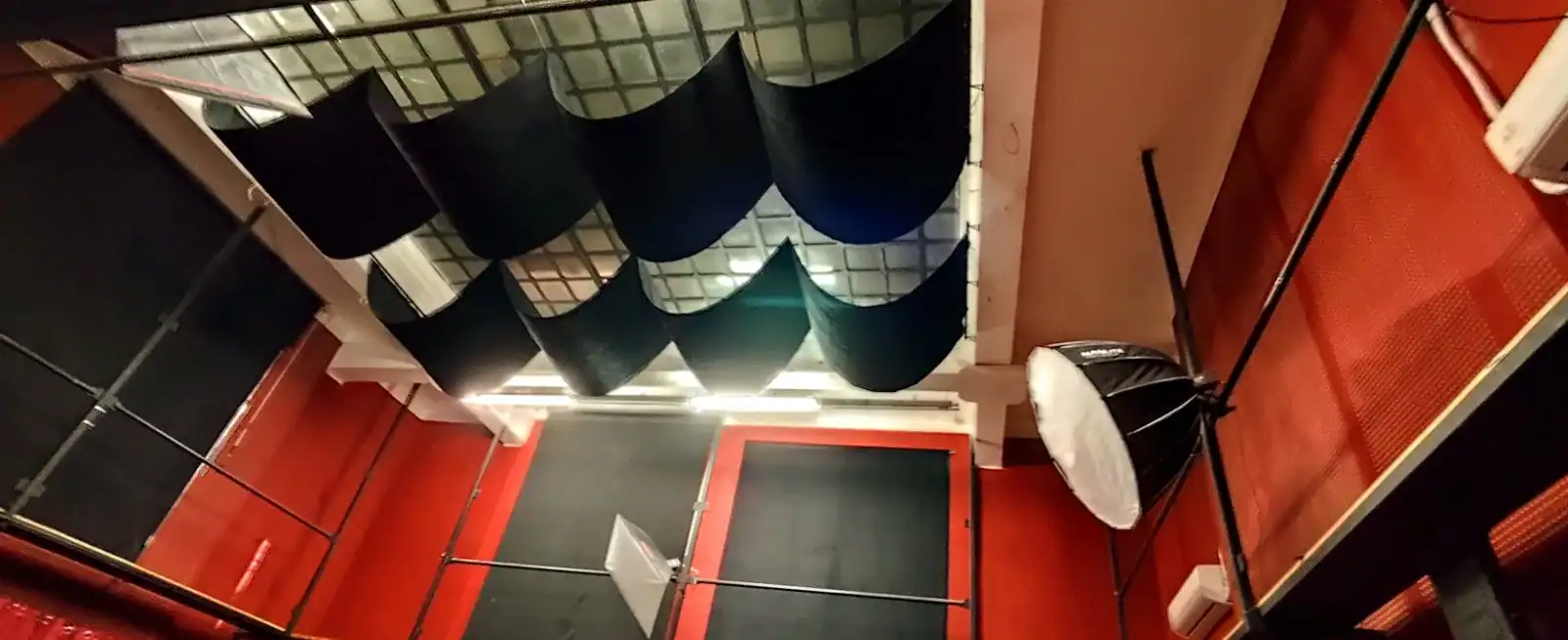
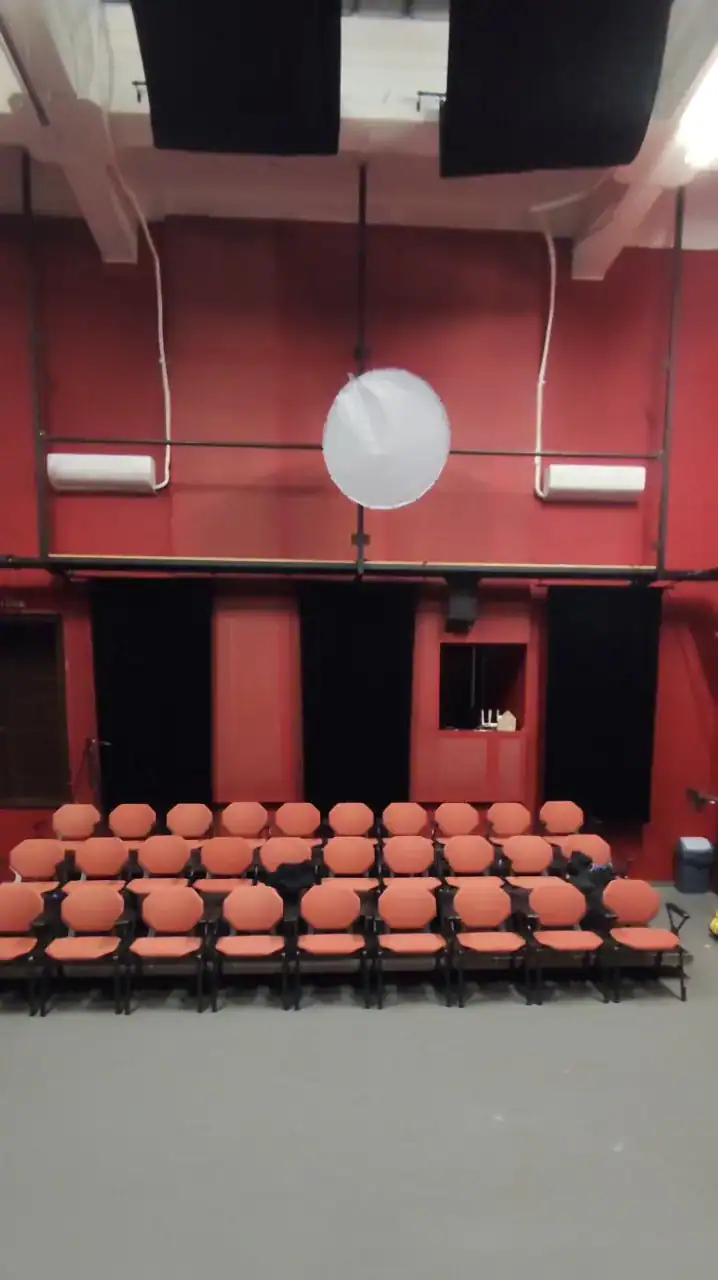
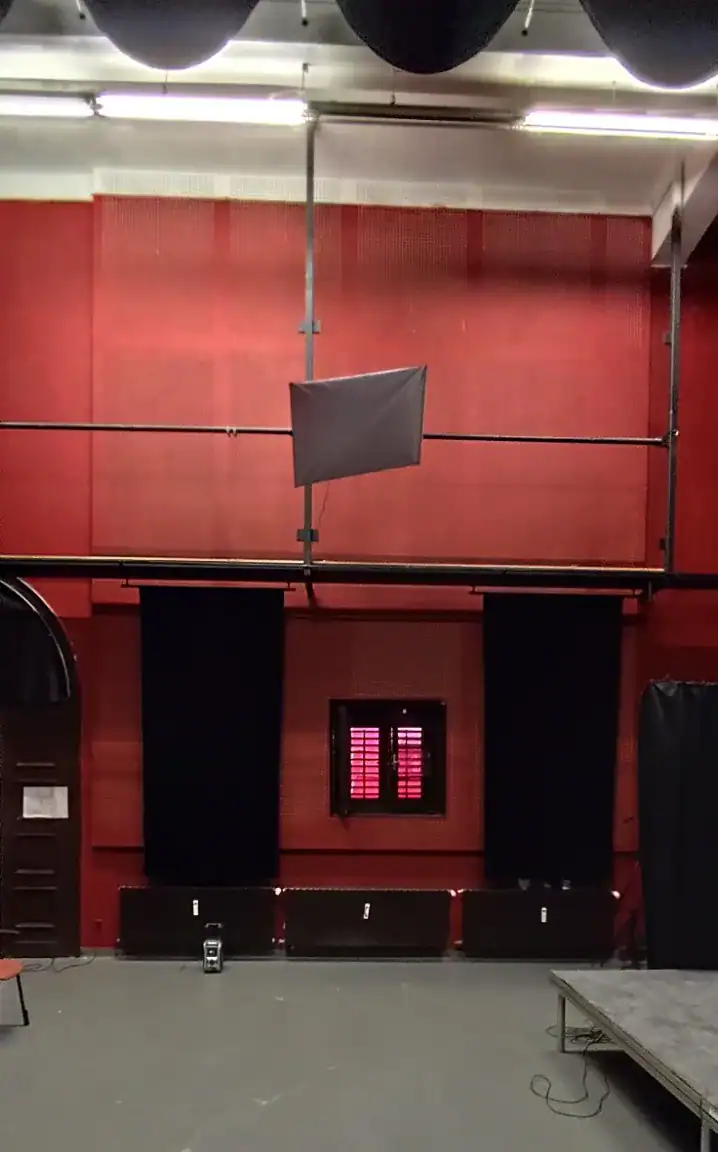
Examples: curtains between two training rooms – ATENDIA, a double black acoustic curtain on a special bent track for a hall at Kaufland Bulgaria, curtains under the ceiling and on the walls of the hall at the Red House in Sofia, and a curtain along a whole studio wall.
Sound absorption: laboratory data for the two fabrics
We sew the curtains from two flame-retardant cotton velvet fabrics:
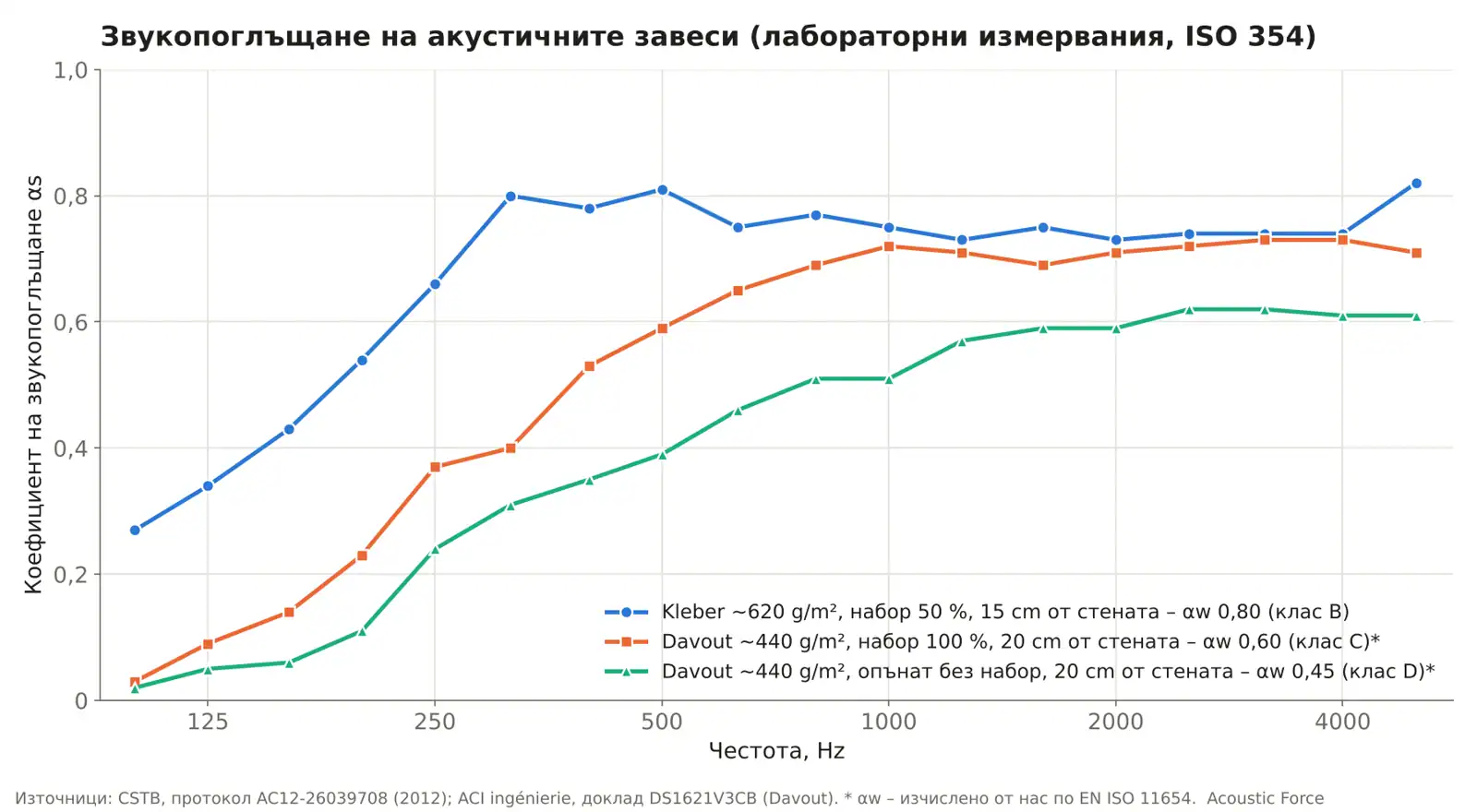
- Kleber, ~620 g/m² – with 50% fullness and 15 cm from the wall, αw = 0.80, sound absorption class B (CSTB, report AC12-26039708, ISO 354);
- Davout, ~440 g/m² – with 100% fullness and 20 cm from the wall αw ≈ 0.60 (class C), flat without fullness – αw ≈ 0.45 (class D). Measured to ISO 354 (ACI ingénierie); we calculated αw to EN ISO 11654.
| Frequency, Hz | 125 | 250 | 500 | 1000 | 2000 | 4000 | αw |
|---|---|---|---|---|---|---|---|
| Kleber, 50% fullness | 0,35 | 0,65 | 0,80 | 0,75 | 0,75 | 0,75 | 0,80 (B) |
| Davout, 100% fullness | 0,10 | 0,35 | 0,60 | 0,70 | 0,70 | 0,70 | 0,60 (C) |
| Davout, flat | 0,05 | 0,20 | 0,40 | 0,55 | 0,60 | 0,60 | 0,45 (D) |
The octave-band values are the practical coefficients αp to EN ISO 11654. The folds and the air gap behind the curtain increase absorption, especially at low frequencies – so in a design we choose not only the fabric but also the fullness and the distance from the wall.
Sound insulation: how many layers are needed
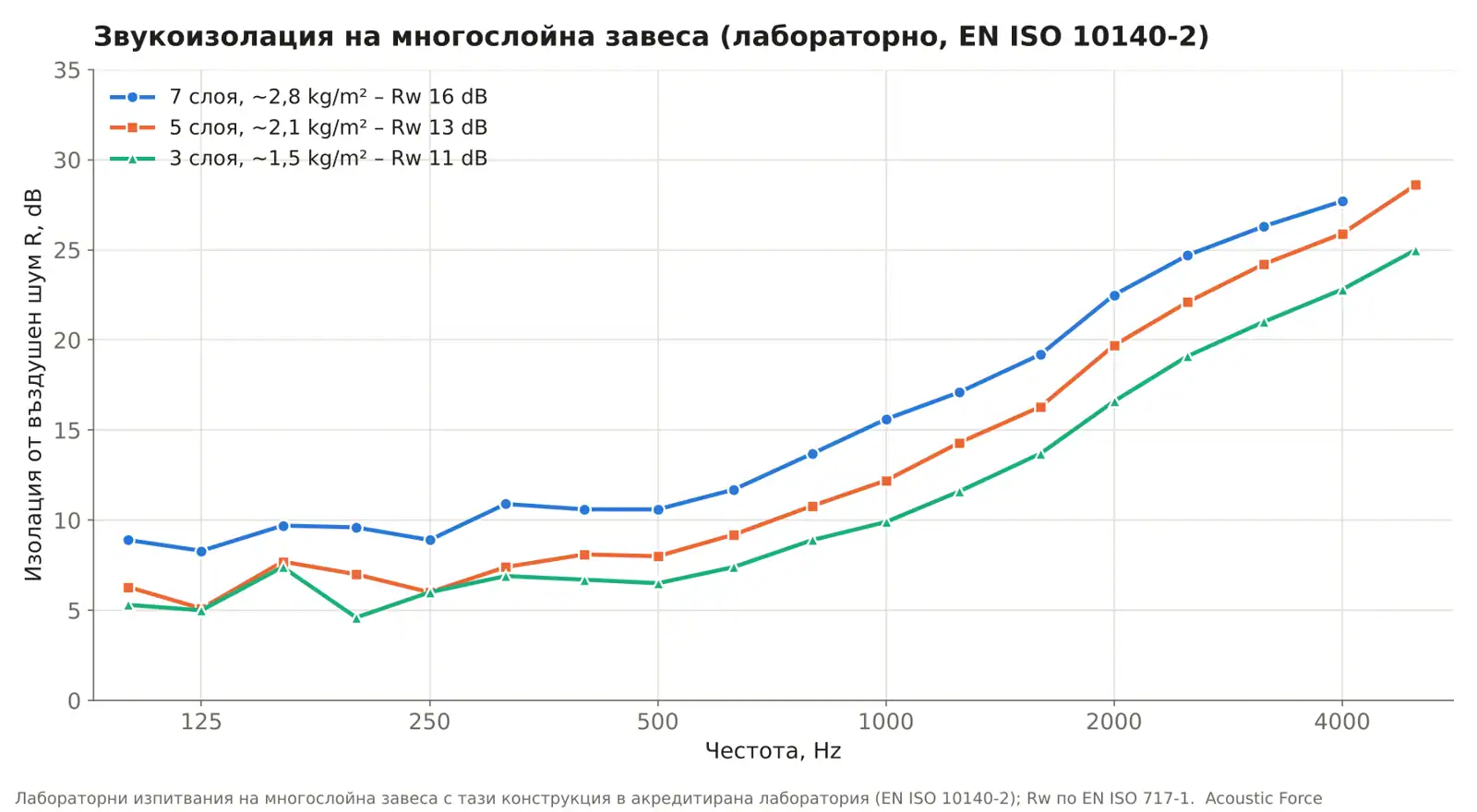
A single curtain, however heavy, insulates by only a few decibels. For more, we sew a multi-layer curtain: two velvet face layers and inner layers of molton and dense coated fabric, with an air gap between them. Laboratory tests of multi-layer curtains of this construction (accredited laboratory, EN ISO 10140-2, Rw to EN ISO 717-1) give:
| Layers | Weight | Rw |
|---|---|---|
| 3 | ~1,5 kg/m² | 11 dB |
| 5 | ~2,1 kg/m² | 13 dB |
| 7 | ~2,8 kg/m² | 14–16 dB |
| 10 | ~3,6 kg/m² | up to ~21 dB* |
| 12 | ~4,5 kg/m² | up to ~26 dB* |
* Indicative values; the 12-layer curtain was measured on site, not in a laboratory. The weights are indicative. We can sew a curtain with this many layers and this weight if the project requires it.
For comparison: a plasterboard partition wall typically has Rw of about 40–50 dB. A multi-layer curtain is a solution when a room needs to be divided, but it does not replace a wall. With a single curtain between two rooms (ATENDIA) we measured a 4.5 dB improvement.
Features
Function
Sound absorption in the room and dividing the space
Fabric
Flame-retardant cotton velvet – Kleber (~620 g/m²) or Davout (~440 g/m²); reaction-to-fire class M1 (French classification)
Sound absorption
αw up to 0.80, class B (Kleber, 50% fullness, laboratory)
Track
Specialised, rated for the curtain’s weight; with bent corners where needed
Colour
Your choice; most often black
Soundproofing
Single curtain – a few dB; multi-layer – Rw 11–16 dB (laboratory)
When it is the right choice
- The room needs to be both one space and several. The curtain divides the space when needed and is drawn back when it is not.
- Building work is not possible. The curtain is installed in a few days, with no construction work.
- A stage, an event room, a gym. Besides dividing, the curtain absorbs sound and reduces echo.
When it is not enough: when speech from the next room must not be understood. Then a barrier is needed – see how we measure sound insulation and acoustics for public buildings.
"*" indicates required fields