
The need for soundproofing in homes is a topic that has been discussed for over fifteen years. In times of pandemic and the advent of remote working, it has gained particular popularity. A 2015 study shows that while 50% of the world's population lives in cities, in Europe the percentage is even higher – three quarters or 75%. With the growing demand for housing in urban areas, built-up areas are becoming increasingly densely populated, which increases the need to improve the quality of construction in terms of Sound Insulation. It is strongly influenced by the investor's intentions and the responsible actions of the contractor.

The World Health Organization's opinion on sound insulation in homes
The WHO defines health as "a state of complete physical, mental, and social well-being, and not merely the absence of disease or infirmity." In this context, the impact of noise on health should not be understood solely as an adverse physical effect, but also as a disturbance of mental and social well-being. Noise from neighbors can act indirectly as a catalyst for harmful effects on health through various mechanisms. The degree of impact depends on many factors, such as health profile, external circumstances, mental state, physiological sensitivity of the hearing apparatus, perception, or control over the noise problem. According to the study, household noise can cause sleep disturbances, irritation, emotional reactions, and disruption of daily routines. Neighborly relations also influence the reaction to and degree of irritation caused by noise.
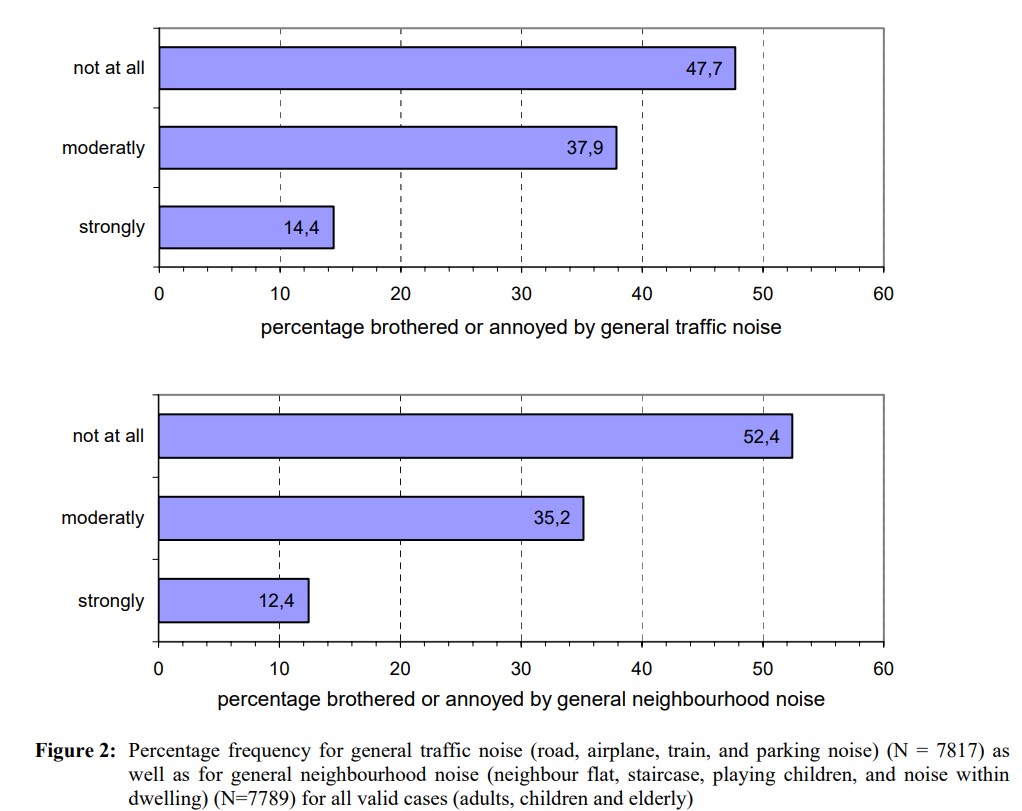
According to a WHO report, the strongest effect of a noisy environment on humans is irritation. This manifests itself in discomfort, fear, threat, insecurity, a feeling of restricted freedom, frustration, or defenselessness. According to the data from this study, the percentage difference between irritation from traffic noise and noise from neighbors is small. In the case of traffic noise, 37.9% of respondents reported moderate irritation and 14.4% reported severe irritation, while in the case of noise from neighbors, 35.2% reported moderate irritation and 12.4% reported severe irritation.
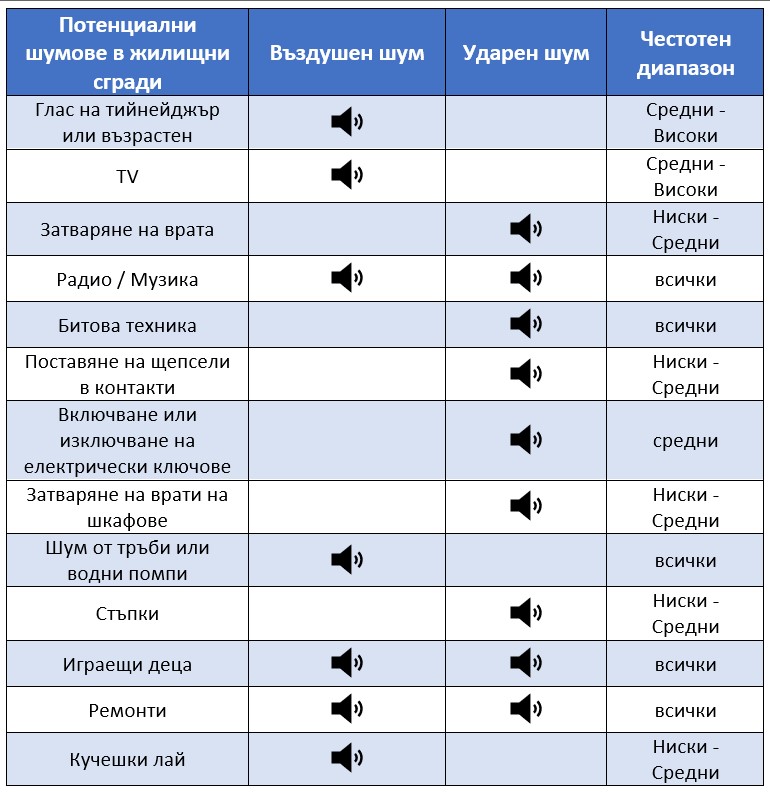
Types of noise that should be limited in the home
People can accept that it is impossible to completely isolate noise. However, they cannot accept hearing sounds from the television and radio, conversations, and household appliances. These types of sounds fall into different categories depending on their frequency characteristics. According to an in-depth analysis, different types of noise are classified as low-frequency (40-200Hz), medium-frequency (250-1000Hz), and high-frequency (1250-3000Hz).
In the coming decades, tens of thousands of homes will be built across the country. In view of the changes that took place in early 2020, the need to ensure a quieter and more comfortable environment in residential buildings is growing. This can be achieved through stricter control over the implementation and enforcement of existing regulations on noise in dwellings and the environment. This is important not only for new buildings but also for existing ones. The introduction of criteria for assessing buildings according to their degree of acoustic comfort would have a positive impact on this problem, as has already been done in a number of European countries such as Germany, France, Austria, Denmark, Norway, Turkey, and many others.
This article is an interpretation and partial direct translation of scientific publications by Professor Rasmussen, part of publications under COST Action TU0901.
Sources:
Rasmussen, B., Machimbarrena, M. COST Action TU0901 – Building acoustics throughout Europe Volume 1: Towards a common framework in building acoustics throughout Europe. Ch 1 Profiling Existing and New Build Housing Stock by Smith, S.
Rasmussen, B. ,Sound insulation in multi-storey housing in Europe – Situation Anno 2017 and needs for upgrading. Inter Noise, Hong Kong, 2017
Rasmussen, B., Building acoustic regulations in Europe – Brief history and actual situation Birgit, Baltic-Nordic Acoustic Meeting, Harpa, Reykjacik, Iceland, 2018
S. Stansfield, M. Haines and B. Brown. Noise and health in the urban environment. London, 2000.
Niemann, H. , Maschke C. , Noise effects and morbidity, 2004
R.S. Smith, J.B. Wood and R.G. Mackenzie. Housing and Sound Insulation, Scottish Government. Arcamedia, Edinburgh, UK, 2005