
Whether we want to sleep peacefully in our bedroom, work in a quiet environment in the office, or To limit noise from the disco, we need to ensure good sound insulation in the room we live in. To achieve this, it is important to understand how sound insulation works and what factors determine it. The right approach and selection of materials can save us money and protect us from bad practices.
In a series of articles, we will try to familiarize you with the basic principles, materials, and details of soundproofing rooms in accessible language and without too many formulas. We will discuss:
- What are the factors that determine the sound insulation of rooms?
- what are the types of sound insulation systems;
- Which properties of building materials affect the sound insulation index and how to combine them;
- important details that compromise the sound insulation of the rooms.
Key factors

In this first part, we will introduce you to the two main factors that determine the sound insulation of a room. What is their contribution to acoustic comfort and how are they interrelated?
The first factor considered in building acoustics is the so-called sound insulation index of the element. Whether it is a wall, ceiling, window, door, floor, or opening, they all have a sound insulation index. It is very important to note that we are talking about building elements, not building materials. The sound insulation index is not a property of the material, but a characteristic of the system. In this regard, we should clarify that the material is always part of a system. For example, in masonry, the building material is ceramic brick, and the wall built with mortar and many bricks is the system on which we determine the sound insulation index.
What is a sound insulation index?
Simply put, this is a characteristic of a given element that determines how much sound it blocks. The higher this index, the better the sound insulation of the element. The sound insulation index is determined in decibels [dB] and is always a positive number. This sound insulation index can be obtained in two ways, through laboratory measurements or through computational models. It is important to note that determining this index, and more precisely its unit value, which is presented in technical data sheets or studies, is not simply a mathematical difference between the level in one room and the level in another room.
Why can't we use simple techniques to determine the sound insulation index?
This is because the assessment of an element's ability to stop a certain amount of sound energy depends on several factors, namely:
- the spectrum of the sound signal that is emitted and received.
- the volume of both rooms.
- the reverberation of the receiving room (or, more simply, the "echo" in the room).
This peculiarity stems from the physics of wave processes in enclosed spaces, which can lead to incorrect assessment of the sound insulation of the same element placed in two different environments. What does this mean? Let's examine our element in a laboratory in London and in a laboratory in Sofia. Let's assume that the two laboratories have rooms that are identical in volume and geometry, but in London the receiving room is filled with furniture and acoustic materials and there is no "echo." Well, when we measure the values, we will find that the same element in London gives better results. Why? Well, because in one case the sound energy that has passed through continues to "hit" the walls and increase the level in some places, while in the other it fades away and a lower level is obtained. So, which of the two values is correct? Well, the answer is neither. When calculating the sound insulation index, correction factors are introduced, which are a function of the reverberation in the room. And to be more precise, these factors, especially for the Rw index, are a function of the equivalent sound-absorbing area.
Frequencies and unit values
Another important thing to know about the Rw sound insulation index is that it is measured in a narrower frequency range (from 100 to 3150Hz) than the human ear is capable of detecting (20Hz to 20,000Hz). This is again due to the peculiarities of the physics of wave processes in a room. Here is the most confusing fact about the sound insulation index. The single value presented to us is not an arithmetic mean of the values obtained across frequency bands, but a so-called weighted value, which is obtained by empirically stopping the second graph and reading the value at 500Hz. It is overly complicated and difficult to understand, but if anyone is interested in learning more about this process, they can find more information here.
What else does the sound insulation index of a room depend on?
When determining the sound insulation index of a given element in laboratory conditions, all elements of both rooms are separated by elastic connections, and the test sample is placed only in one part of the room. This is done in order to eliminate the influence of surrounding elements on the test sample, which leads to the second important factor affecting the sound insulation of a room.
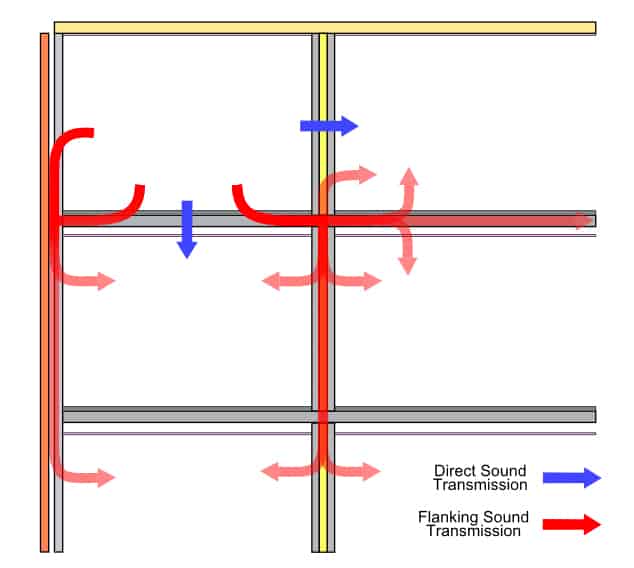
It is related to the connection of all elements to each other and their individual sound insulation indices. When we have two rooms with a common wall or two rooms with a common slab, the sound insulation index is determined not only by the common element, but also by the interaction of the other elements with each other. Or, to put it more simply, it is the transmission of noise via bypass routes. What does this mean? Let's consider the case where we have two rooms located next to each other with a common wall. The sound energy is transmitted not only through the common wall, but also through the side walls, the floor, and the ceiling. The amount of energy that will pass through them depends mainly on the type of connection between them. Whether they are separated in some way elastically (by rubber strips and pads) or are rigidly connected to each other (by dowels or mortar) determines how much energy will pass through them. In 99.9% of cases in construction, we have rigid connections between the elements. Then the sound insulation of the room depends on the indices of all elements.
What will we tell you in the next articles?
In the next article, we will introduce you to the types of elements in building acoustics. Which properties of materials affect the sound insulation index of the system and how we can achieve the most effective sound insulation.