
One of the biggest hurdles that beginners face when making their first home recording is that they severely underestimate the importance of room acoustics.
A nice microphone and expensive studio monitors are not enough. The acoustics of your room have a big impact on the sound quality.
To save you months of frustration while trying to figure out what you're doing wrong, we've outlined the step-by-step process of designing an acoustic treatment for your home studio.
Acoustics
Before getting started with acoustic processing, it's good to have a basic understanding of acoustics.
Here are some basic concepts:
How does sound travel in the room and why is it important for good sound insulation?
Whenever a sound is heard in the room, the following happens:
- Coming from the source, it projects outwards in all directions.
- A small part of it (known as direct sound) moves in a straight line to the microphone.
- The residue (known as reflected sound) bounces randomly between the surfaces of the room.
- Later, some of these reflections reach the microphone accidentally and for fractions of a second.
Why most rooms have poor acoustics
The problem is that rooms with excellent acoustics require money to build them and this is a problem with soundproofing.
And since we don't all have them, here's how we "fake" the ideal tone:
How to "fake" an ideal room tone
Back in the 1960s, a machine known as the Echo Chamber was invented. It allowed engineers to simulate the reverberation of a room different from the one in which it was recorded. Over the years, the technology has become increasingly sophisticated and today software programs known as digital reverberation can simulate the sound of almost any acoustic environment.
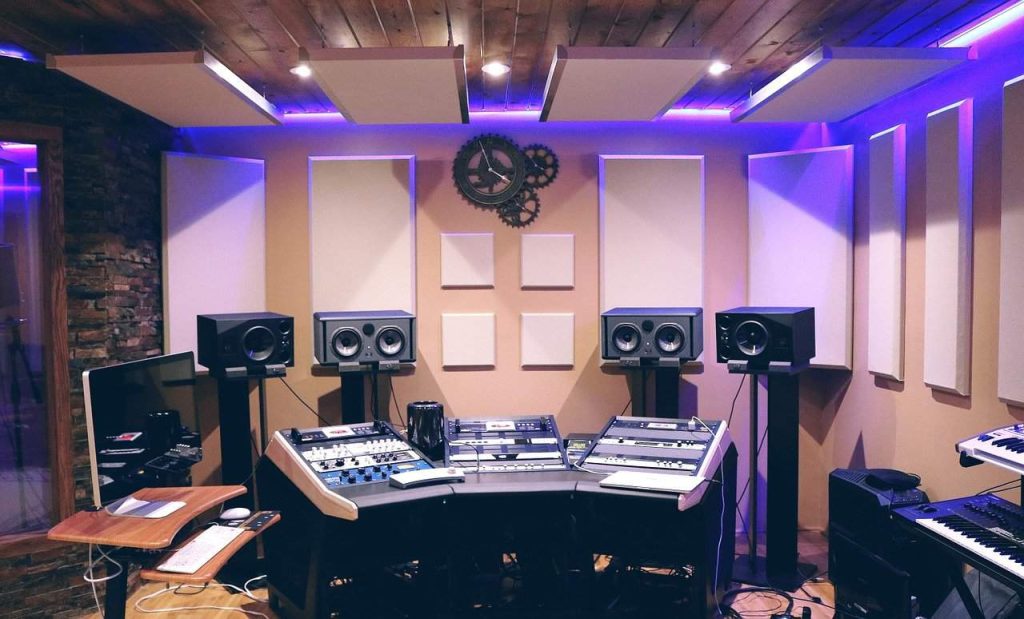
The only catch is that to be able to add the "fake" reverb, you must first remove the real, true reverb.
Here's how you can do that:
What are the factors that determine the sound insulation of a room?
Ever notice those foam panels on the walls of recording studios? While they may look really interesting, their real purpose is to absorb sound reflections.
Usually these reflections are recorded, but with acoustic absorption, only the direct sound from the instrument to the microphone remains, which is exactly what we want.
In practice, many people find that absorption actually works best in combination with another type of acoustic treatment known as diffusion.
Here's how it works:
How diffusion can improve sound
When you remove all sound reflections with absorption, many people find the room sounds too desolate and uninhabitable. The solution here is to leave a few reflections and disperse them with diffusers.
Usually untreated reflections cause problems because they get trapped in one place and amplify some frequencies while cancelling out others. Thus the natural frequency balance is destroyed.
Diffusers work by scattering reflections so nothing is trapped and the natural tone is preserved.
With the right combination of absorption and diffusion, you can transform the acoustics of almost any room to be comparable to a world-class sound room.
Now that you understand the basics of acoustics, the next step is applying these principles to your room by adding acoustic processing.
You're already one step ahead of having good room soundproofing.